5 Things to Know About Orecchiette Pasta in Bari
Discover the famous pasta ladies of Bari. Learn where to find them in Arco Basso, how they make handmade orecchiette, and the best way to eat it.
On this page
5 Things to Know About Orecchiette Pasta in Bari
Walking through the stone gates of Bari Vecchia, the scent of toasted grain fills the air immediately. You will hear the rhythmic clicking of knives against wooden boards before you see the workers.
This ancient sound signals your arrival at the heart of the city's culinary soul. These women preserve a tradition that has defined Pugliese culture for many centuries.
Understanding the culture of orecchiette pasta in bari requires looking beyond the plate. It is a living performance of history played out daily on the sun-drenched streets.
The History of the "Little Ears" in Bari Vecchia
Historical records place this pasta shape in Puglia as far back as the 12th or 13th century, making it one of the oldest documented pasta forms in southern Italy. The Pugliese plains, known as the Tavoliere, have grown durum wheat since antiquity, and the local diet was shaped entirely by what this hard grain could produce.
The dough requires only two ingredients: coarse durum wheat semolina and warm water. That simplicity is intentional. The hard grain resists overcooking, stays firm in heavy sauces, and dries without additives — essential qualities in an era before refrigeration. The semolina’s golden color, its faint smell of toasted grain, and its slightly gritty texture before cooking are all markers of an authentic batch.
The name translates literally to "little ears," a reference to the concave dome each piece forms when rolled over a thumb. That hollow cup shape is not decorative — it was engineered to trap thick vegetable sauces, pools of olive oil, and garlic-anchovy drippings so that every bite carries the full flavor of the dish beneath it.
The women who make orecchiette today learned the skill before they could read. Angela Lastella, now 68, recalls being taught by her grandmother at age five — woken before school to help set out the boards. As noted by El Pais: Bari’s Guardians of Pasta, these women have spent their lives guarding a manual art form that industrial production has never successfully replicated. The tradition endures because the knowledge lives in hands, not machines.
Where to Find the Famous Pasta Ladies of Arco Basso
The most famous concentration of pasta makers sits along a narrow stone passage called Arco Basso, directly across from the entrance to the Castello Svevo in Bari Vecchia. The street is sometimes called Strada delle Orecchiette, though locals simply say "Arco Basso." Do not confuse it with the nearby Arco Alto — that passage runs parallel but has no comparable pasta activity.
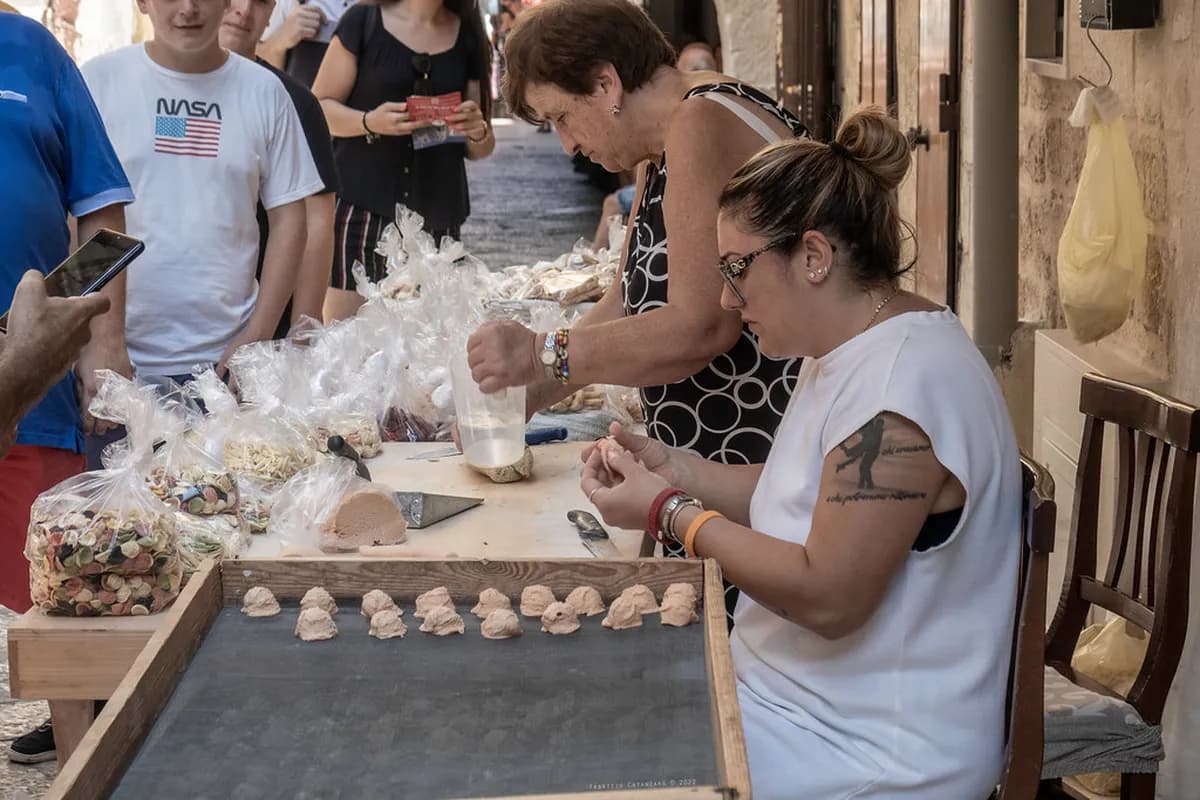
By 10 AM every morning — rain or shine, summer or winter — the women carry their wooden boards to the street outside their front doors. Tables are pushed to the edges of the alley. Small mountains of semolina appear. The smell of warm grain fills the passage before you even round the corner. You hear the rhythmic scrape of serrated knives on wood well before you see the workers.
What makes Arco Basso unusual is that the making and the selling happen simultaneously in front of the makers' own homes. This is not a market stall or a demonstration — these women are producing kilos of pasta for restaurants, tourist bags, and their own family lunches, all in public view. Neighbors gossip across balconies above. Husbands linger at the bar under the arch at the far end. The whole street operates as an informal cooperative held together by decades of social habit.
The 1 PM deadline is real and worth planning around. By midday, most women wind down production because they need to cook lunch before the men return home. Arriving between 09:00 and 11:00 gives you the best combination of peak production, full stock, and natural light for respectful photography. It is a vital stop on any Bari street food guide itinerary.
Fresh pasta dries on large wooden frames propped against the limestone walls throughout the morning. Rows of golden shapes catch the Mediterranean sun — a visual that has driven millions of social media posts and helped transform these women into unlikely international figures.
Always ask permission before taking photos of the women at work. Most are happy to pose, but respecting their workspace ensures a warm reception and supports the local tradition.
The Traditional Technique: From Dough to Shape
Authentic orecchiette requires only two ingredients: coarse durum wheat semolina and warm water. No eggs, no oil, no additives. The maker pours the semolina onto a spianatoia — the heavy wooden board — forms a well in the center, and adds warm water in a slow stream while working the dough with both palms until it becomes a firm, smooth yellow ball. The semolina's coarse grind is non-negotiable: finely milled flour produces a surface that is too slick for the sauces to grip.
The shaping follows a precise sequence known as the "strascinate" technique, named from the Italian verb meaning "to drag." The maker rolls small portions of dough into ropes about the thickness of a finger, then cuts them into nuggets roughly the size of a hazelnut. She places the flat of a wide, serrated knife against the nugget at a slight angle and drags it toward herself across the board in a single firm stroke. This dragging action creates a small curled shell called a cavatelli, with ridged grooves on the outer surface. She then flips the cavatelli over her thumb, turning the shell inside-out to form the characteristic concave dome. The rough inner surface produced by the drag is now on the outside — exactly where it needs to be to catch sauce.
Experienced makers complete this sequence in under two seconds per piece without looking at their hands. As noted by An American in Rome: The Orecchiette Ladies, the rough, porous texture achieved by this hand-drag is the key quality that machine-made orecchiette cannot replicate. Industrial versions are pressed into moulds; the surface is smooth and repels oil-based sauces rather than absorbing them. The difference is immediately visible in the plate — and in the price tag.
How to Eat It: The Classic Orecchiette alla Barese Recipe
The non-negotiable dish is orecchiette con cime di rapa — pasta with broccoli rabe — and it is only served during the autumn and winter months when the bitter greens are in season. The greens are blanched briefly in salted boiling water alongside the pasta itself, then pulled out and set aside. In the same pan, garlic is gently softened in olive oil over medium heat; salted anchovies are added and stirred until they dissolve completely into the fat, creating a savory base the Pugliese call the soul of the dish.
The blanched greens go into the pan with the anchovy oil, the drained pasta follows, and the whole mixture is tossed together over high heat for sixty seconds. Some cooks finish with a pinch of dried chili. The dish is never served with cream or butter. Instead of expensive aged cheese, locals scatter toasted breadcrumbs fried in olive oil across the top — a preparation known locally as "poor man's cheese" that adds crunch without overpowering the bitterness of the rapa.
In the warmer months when cime di rapa is unavailable, the sauce shifts to a simple tomato and ricotta mixture. On Sundays, Pugliese families traditionally serve orecchione — the largest size — with braciole ragu: slow-cooked meat rolls stuffed with parmesan, garlic, and bacon. If you want to try this dish prepared by experts, consult the best restaurants in Bari list for trattorias in the old town that still follow the original recipe.
Pairing the dish with a glass of local Primitivo from the Manduria DOC zone adds depth: the wine's dark fruit and slight earthiness complements the bitterness of the rapa without competing with the anchovy. This combination is the essence of a Sunday lunch in a Pugliese household in 2026.
Practical Tips for Buying and Storing Fresh Pasta
Buying directly from the street is a highlight of any cheap eats in Bari itinerary. A large bag of fresh pasta usually costs between five and ten euros in 2026.
You should bring small bills in cash because these street vendors rarely accept credit card payments. Always ask for permission before taking close-up photos of the women while they are working.
If you plan to fly home, allow the pasta to air-dry for at least 24 hours first. This prevents mold from forming inside plastic bags during your long journey back to your home country.
Check the texture of the pasta before you buy to ensure it feels slightly rough to the touch. This artisanal quality is the primary reason to choose handmade over supermarket brands.
You can find more travel advice and destination insights at Italy Wander for your next trip. Proper storage and handling will ensure your Italian flavors last long after you return.
- Handmade vs Industrial Pasta Comparison
- Texture: rough and porous surface
- Sauce: superior adhesion for oils
- Ingredients: 100% durum wheat semolina
- Cooking: remains firm and chewy
- Visitor Etiquette and Buying Rules
- Payment: strictly cash only transactions
- Photos: ask before filming workers
- Timing: visit before 1 PM daily
- Language: learn basic Italian greetings
- Transporting Fresh Pasta Safely Home
- Drying: 24 hours on mesh
- Packing: use breathable paper bags
- Storage: keep in cool dry places
- Longevity: lasts months when dried
Small, Large, and Giant: How Size Changes the Dish
Not all orecchiette sold at Arco Basso are the same. The women produce three distinct sizes, each suited to a different preparation, and understanding the difference helps you buy the right bag for what you plan to cook at home.
The smallest variety — roughly the size of a lentil — is the standard orecchiette used for cime di rapa and lighter vegetable sauces. Its compact cup traps enough liquid for flavour without becoming waterlogged, and it cooks through in about eight minutes. This is the shape most people picture when they imagine the dish.
The medium size, simply called orecchiette grande, is better suited to thicker tomato-based sauces where the pasta needs more structural presence in the bowl. Local restaurants pair it with ricotta and tomato in summer and with braciole ragu in winter.
The giant version — the orecchione, or "big ear" — is the one that stops tourists in their tracks. Each piece is roughly the size of a small walnut, with a wide, deeply cupped interior designed to hold hearty slow-cooked meat sauces. A bag of fresh orecchione makes an excellent souvenir because it is unlikely to be found outside Puglia and keeps for months once fully dried. When buying, ask specifically for the orecchione if the giant size is what you want — the word "orecchiette" alone will usually get you the smallest variety by default.
The Spianatoia: Why the Tools Make the Pasta
The wooden board used by the Arco Basso women — the spianatoia — is central to why handmade orecchiette tastes different from anything produced in a factory. Over years of daily use, the board develops a surface texture from thousands of drag strokes: faintly grooved, never sealed with oil or varnish, slightly absorbent. That texture is transferred to the pasta itself during the strascinate drag, leaving microscopic ridges across the outer surface of every piece.
The knife matters equally. The women use a wide-bladed knife with a serrated edge, held at a low angle rather than perpendicular to the board. The serrations bite into the dough as it drags, creating the irregular grain pattern on the surface. A smooth-bladed knife would produce a cavatelli with a slick exterior — functional, but unable to hold an oil-based sauce the way the ridged version does.
Industrial orecchiette is pressed into metal moulds under high pressure. The surface is compressed and sealed rather than opened and roughened. When you cook it in boiling water and drain it, olive oil slides off; the pasta sits in a puddle at the bottom of the bowl. Handmade orecchiette absorbs the oil into its porous surface and holds it through every toss in the pan. This difference — felt clearly when you eat the two versions side by side — is the reason the women of Arco Basso still have a market in 2026, despite supermarkets stocking orecchiette at a fraction of the price.
Frequently Asked Questions
Where is the pasta street in Bari?
The famous pasta street is located at Arco Basso in Bari Vecchia. It is situated directly across from the entrance of the Castello Svevo. You can find more details in our Bari food guide for easy navigation.
What is the best time to see the pasta ladies?
You should visit between 9 AM and 12 PM for the best experience. Most women finish their public work by 1 PM to cook for their families. Morning light also provides the best opportunities for respectful photography.
Can you buy orecchiette to take home?
Yes, you can purchase bags of fresh or semi-dried pasta directly from the tables. Ensure you let fresh pasta air-dry completely before packing it in a suitcase. This prevents the dough from spoiling during your flight.
What is the traditional way to serve Bari orecchiette?
The most traditional preparation uses cime di rapa, garlic, and anchovies. Locals often add a pinch of chili flakes for heat and toasted breadcrumbs for crunch. It is rarely served with heavy cream or butter.
Experiencing the culture of orecchiette pasta in Bari is a journey into the heart of Italy. The dedication of the Arco Basso women ensures this culinary art remains relevant for future generations.
By visiting these artisans, you support a local economy that values quality over mass production. Your trip to Bari will be defined by the simple joy of a handmade meal.
Take the time to listen to the clicking knives and smell the fresh semolina flour. These sensory details create memories that last much longer than any souvenir you might buy.
For the bigger picture, see our What To Eat In Bari guide — or dive into Best Restaurants In Bari Travel Guide and 10 Essential Tips for the Ultimate Bari Street Food Guide.
You might also like


Continue reading
More guides you'll find useful