Matera Film Locations Guide Travel Guide
Plan matera film locations guide with top picks, neighborhood context, timing tips, and practical booking advice for a smoother trip.
On this page
Matera Film Locations Guide
The city of Matera looks like a living movie set carved from ancient stone — and for more than 70 years, it has been exactly that.
This UNESCO-listed destination has hosted directors from Pier Paolo Pasolini in 1964 to Cary Fukunaga in 2021, drawn by limestone streets that can double as ancient Jerusalem, mythological Greece, or a Cold War spy thriller backdrop.
A focused matera film locations guide helps you identify the actual streets and viewpoints used in productions — not just the tourist highlights — so you arrive knowing which district framed which scene.
Whether you are here for James Bond's Aston Martin chase, Mel Gibson's biblical epic, or the longer arc of Italian neorealist cinema, the Sassi rewards visitors who explore it deliberately.
Must-See Matera Attractions
The Sassi districts represent the heart of the city's ancient architecture and cinematic appeal.
Walking through the Sassi's limestone lanes feels like stepping onto a standing film set — because it essentially is one. Matera's two ancient districts have served as Jerusalem, Nazareth, ancient Rome, and a fictional Cold War Italian city within the same stretch of streets, a versatility that no purpose-built film lot can replicate.
The Sasso Caveoso, the older and steeper of the two quarters, provided the Jerusalem sequences in The Passion of the Christ and the biblical town at the heart of Mary Magdalene (2018). Many travelers follow a Matera Sassi walking guide to navigate these exact spots without getting lost in the unmarked alleys.
The Sasso Barisano, by contrast, is more polished — its renovated cave interiors house boutique hotels and restaurants that served the cast and crew during the five-week No Time to Die shoot in 2019. Together, the two districts give film tourists a natural route: start at the Sasso Caveoso viewpoint at Via Casalnuovo for panoramic James Bond car-chase angles, then work north through the Barisano toward the cave hotels where Daniel Craig reportedly stayed.
- Sasso Caveoso District
- Type: Ancient neighborhood
- Best for: Biblical scenery
- Where: Southern Sassi
- Cost: Free access
- Sasso Barisano District
- Type: Renovated caves
- Best for: Boutique hotels
- Where: Northern Sassi
- Cost: Free access
Museums, Art, and Culture in Matera
Art and cinema intersect constantly inside Matera's carved walls. The MUSMA sculpture museum, housed in the 16th-century Palazzo Pomerici and extending into a network of underground cave chambers, is worth at least 90 minutes — its abstract sculptures gain an eerie atmosphere from the rock-hewn galleries that would not be out of place in a prestige drama. Entry costs €7 in 2026.
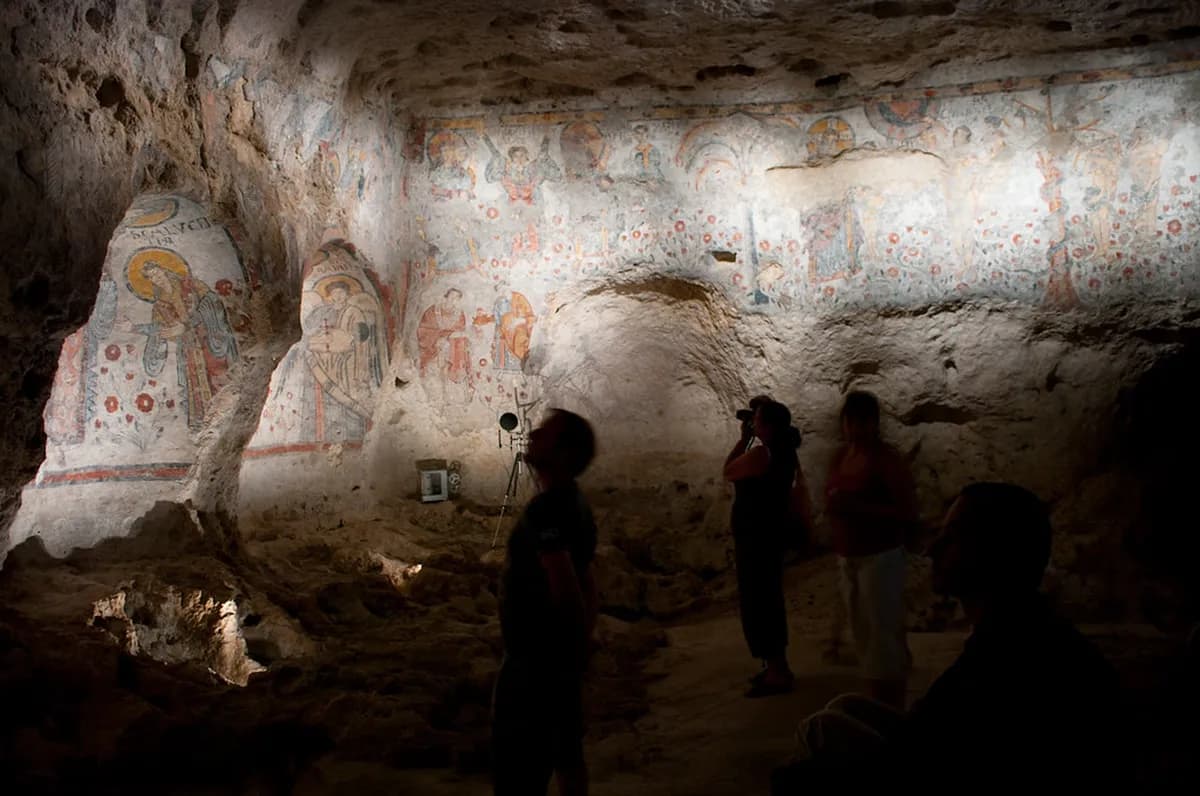
The rock churches are where you feel the strongest echo of the biblical film shoots. Santa Lucia alle Malve, cut directly into the cliff face of the Sasso Caveoso, contains 11th-century Byzantine frescoes that Mel Gibson's production designers studied when developing the visual language of The Passion of the Christ. It is open daily from 09:00 to 20:00 (reduced hours in winter) and costs €4. Nearby, the chiesa rupestre di San Pietro Caveoso sits at the foot of the Caveoso ravine and appears in background shots in multiple biblical productions. Consulting a Matera rock churches guide before you visit clarifies which frescoes are original and which are restorations — important context when you are trying to understand why these specific walls have appealed to directors for decades.
- MUSMA Sculpture Museum
- Type: Art gallery
- Best for: Modern art
- Where: Palazzo Pomerici
- Cost: 7 Euros
- Santa Lucia alle Malve
- Type: Rock church
- Best for: Byzantine art
- Where: Sasso Caveoso
- Cost: 4 Euros
Parks, Gardens, and Outdoor Spots in Matera
The Murgia Materana Park stretches across the ravine from the Sassi, offering the panoramic views of the city skyline that appear in establishing shots across dozens of productions. For film tourists, the key vantage point is the Belvedere di Murgia Timone — a 20-minute walk from the park entrance — where Pier Paolo Pasolini framed his most iconic shots for The Gospel According to St. Matthew (1964). The same rocky plateau also served as an exterior crucifixion site in The Passion of the Christ, with the barren calcite landscape standing in for the hills outside Jerusalem. Consult the Matera Belvedere viewpoints guide to identify the exact rock formations and orientations.
The Tibetan bridge (Ponte Tibetano) is a suspension footbridge that crosses the Gravina gorge — a 40-minute trail from the Piazza Vittorio Veneto side. It is open daily and costs €3 as of 2026. From the bridge mid-span you get a direct line of sight to the entire Sassi, the angle that production location scouts consistently identify as Matera's most cinematically distinctive. Plan to cross at either 07:00–08:00 or 18:00–19:00: the low sun turns the limestone warm amber and eliminates the harsh midday shadows that flatten the cityscape in photographs and on screen.
Family-Friendly and Budget-Friendly Options in Matera
Visiting famous film sets does not have to be expensive for families traveling together.
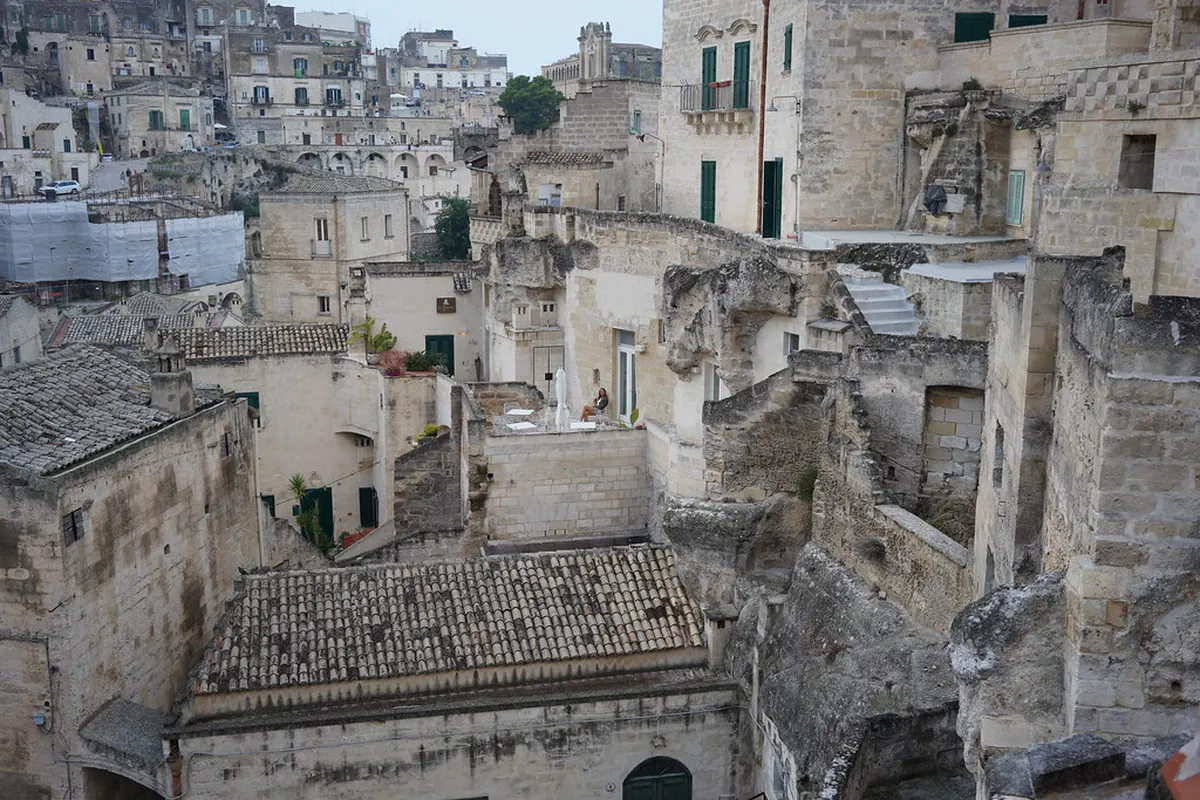
The majority of iconic filming streets — Piazza San Giovanni, Via Madonna delle Virtù, the lanes threading through the Sasso Caveoso — are free to walk at any hour. Families can cover all the major James Bond locations on a self-guided morning stroll of roughly three hours with no ticket purchase required. Budget around €15 per adult for a combined entry to MUSMA and two rock churches if you want the cultural context; children under 12 enter the rock churches free.
Most James Bond filming locations (Piazza San Giovanni, Via Madonna delle Virtù) are free to access and photograph. Commercial guided tours run €25–€50/person but include insider stories about stunts and production logistics.
For families with younger children, the Casa Grotta di Vico Solitario is an excellent paid stop (€3 per person): a reconstructed 20th-century cave dwelling that explains how people actually lived in these spaces before the 1950s resettlement programs. Director Garth Davis used similar interiors as reference locations for Mary Magdalene. Discovering Matera hidden gems also turns up lesser-photographed lanes where you won't be jostling with tour groups. Pack closed-toe shoes with grip — the stone stairs can be slippery in any season and particularly after rain.
How to Plan a Smooth Matera Attractions Day
A successful film locations visit rewards early planning. The Sassi districts are compact — roughly 1.5 km end-to-end — but the vertical topography, steep stairs, and uneven stone paths mean a "short" walk between two sites can take three times as long as a flat-street distance suggests. Build in 20-minute buffers between each named location.
Start at 08:00 to get the soft-angled morning light that made these streets irresistible to location scouts in the first place. By 10:30 on summer days the temperature climbs toward 35°C and tour groups begin filling the main lanes. The Bond car-chase streets are at their best in low light: Piazza San Giovanni, where the Aston Martin DB5 performed its signature drift, looks flat and ordinary under a bleached midday sky but gains deep shadows and three-dimensional texture at either end of the day.
Reviewing the top things to do in Matera helps you weave non-film sights — the Palombaro Lungo underground cistern, the Duomo terrace — into the route without backtracking. If you are booking a guided tour for 2026, look for operators who quote specific scenes and production years rather than generic "cinematic experience" language; the best local guides distinguish between which streets appear on screen versus which ones were merely used for crew logistics.
James Bond Tour in Matera – Following the Footsteps of “No Time to Die”
The opening chase sequence in the 2021 Bond film transformed Matera from a specialist heritage destination into a mainstream travel bucket list. The production — directed by Cary Joji Fukunaga — filmed in Matera for approximately four weeks between August and September 2019. The scale was significant: multiple streets in the old town were closed to residents and tourists, requiring an extensive production agreement with the municipality. Hundreds of crew members worked overnight to protect the ancient stone surface from the weight of production vehicles, using custom matting under track and rigging equipment.
The Aston Martin DB5 chase runs through several identifiable locations. Piazza San Giovanni marks the starting point, where the car performs its first drift. The route then descends via the narrow lanes above the Sasso Caveoso before swinging out onto Via Madonna delle Virtù, the panoramic road along the ravine edge that delivers the aerial shots visible in the film's trailer. Many fans book guided tours through Tripadvisor-listed operators to walk this route in sequence, with local guides pointing out the precise camera angles. In 2026, the standard private Bond tour takes around 2.5–3 hours and covers 10–12 specific filming points.
- Piazza San Giovanni
- Type: Public square
- Best for: Chase scenes
- Where: Near the center
- Cost: Free
- Via Madonna delle Virtù
- Type: Panoramic road
- Best for: Car stunts
- Where: Ravine edge
- Cost: Free
Why sleep like James Bond in Matera?
Staying in a cave hotel offers something a contemporary build cannot: the specific atmosphere that attracted Fukunaga to Matera in the first place. The rock-carved walls maintain a natural temperature of around 15–18°C regardless of the outdoor heat, creating a cool retreat on summer afternoons when the limestone streets outside can reach 40°C. The stone absorbs sound rather than reflecting it, so nights in the Sassi are notably quieter than in comparably priced city centre hotels elsewhere in southern Italy.
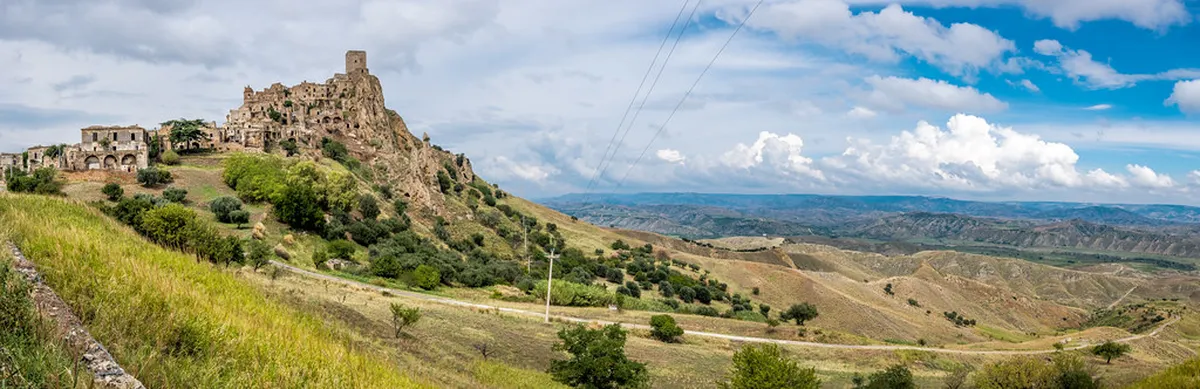
The practical decision for most visitors comes down to location versus price. Cave hotels clustered in the Sasso Barisano tend to be slightly more expensive but put you within a 5-minute walk of the Bond filming route. Options in the Sasso Caveoso are typically €20–€40/night cheaper for equivalent room quality but sit at the southern end of the Sassi, requiring a longer approach from the main viewing terraces. Booking directly with the property rather than through aggregators often yields a better breakfast deal and, in some cases, access to private terraces that face the ravine — the exact view that appears in Fukunaga's aerial establishing shots.
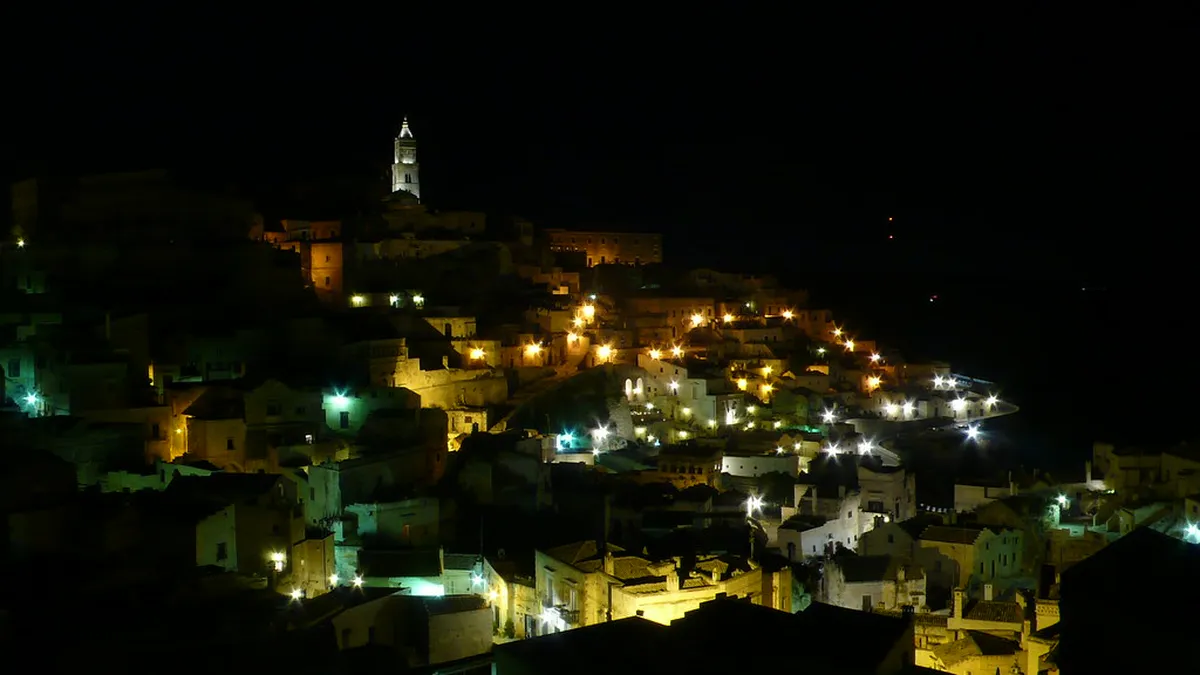
Waking up to a view of the illuminated Sassi before the tourist crowds arrive confirms why filmmakers keep returning: the city is visually extraordinary in the first and last hour of light, and staying inside the stone city rather than in a modern hotel outside means you experience both without the commute.
Sant'Angelo Hotel: Your Bond Base in Matera
The Sant'Angelo Luxury Resort occupies a cluster of interconnected cave dwellings carved into the face of the Sasso Caveoso cliff. During the No Time to Die production, the hotel served as a base for senior cast and crew — a practical choice given its position directly above several of the primary filming streets and its private terraces that offered unobstructed sight lines across the Sassi. The property has since leaned into its Bond association, and in 2026 it markets directly to film tourists with curated room packages that include a walking map of the filming route and a cocktail menu modelled on Bond's preferences.
Room rates sit in the €180–€350/night range depending on season and room category; the cliff-facing rooms with private terrace command a premium but face south across the Gravina ravine, the direction that appears in the film's wide-angle establishing shots. Rooms without a ravine view are considerably cheaper and still offer the core cave-hotel experience. The in-house restaurant operates a small terrace where tables are positioned to face the illuminated Sassi in the evening, making it a serviceable last meal of the day regardless of whether you are staying on site. Booking well in advance (4–6 weeks minimum in summer 2026) is strongly advised; the property sells out quickly around the anniversary weekends of the film's October 2021 release.
Tips for planning your James Bond-inspired itinerary in Matera
Structure your Bond itinerary as a point-to-point walk rather than a loop: start at the Piazza Vittorio Veneto (the main town square at the top of the Sassi) and work downhill through the Sasso Barisano toward the filming route, finishing at the Belvedere di Sasso Caveoso for the ravine-facing panoramic view. Walking downhill is significantly easier on the ankles and knees than the reverse direction, and it mirrors the natural direction of the chase sequence.
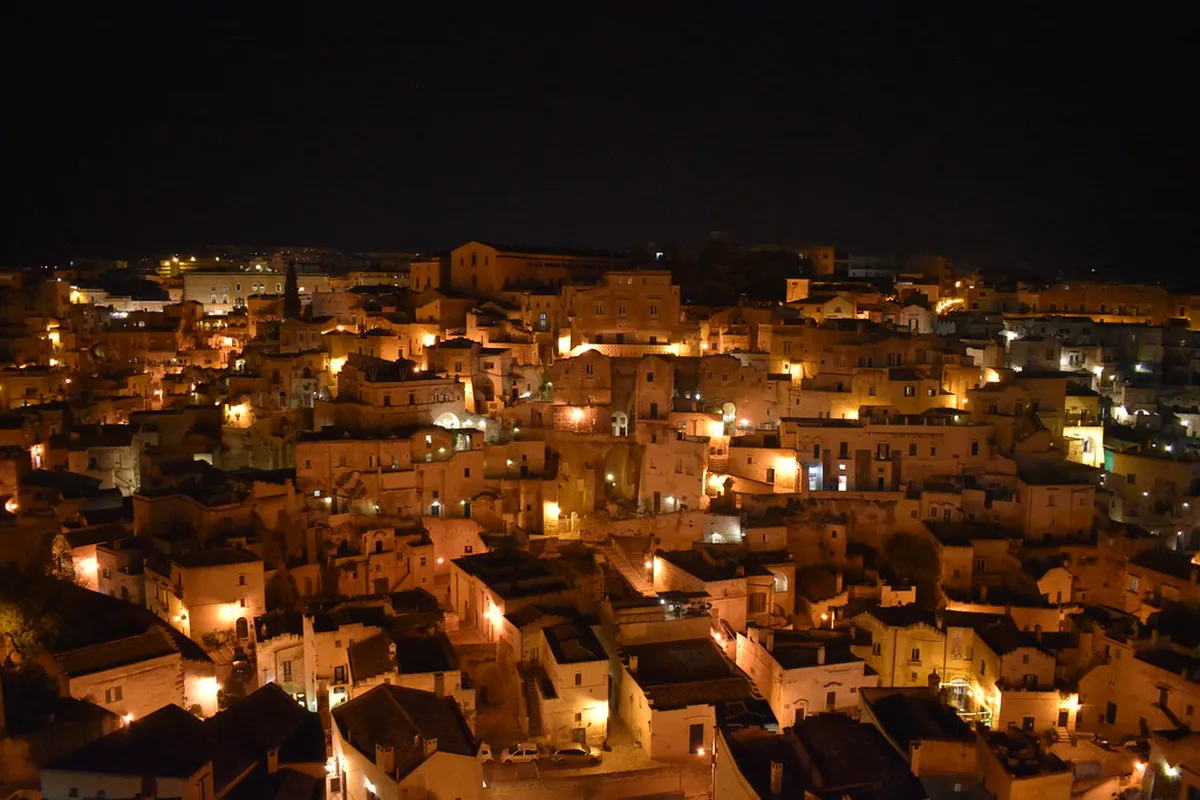
Block out at least 3 hours for the Bond route alone. If you plan to add the Murgia Park viewpoint and the Tibetan bridge, make that a separate half-day afternoon activity: the bridge is best in late afternoon light, and combining both halves of the experience in a single morning leads to rushing the sites. Evening walks through the Sassi are particularly atmospheric when the city lights reflect off the pale limestone — the same amber glow that appears in the film's night sequences.
A visit to a Casa Grotta Matera guide adds 45 minutes to the itinerary but is worth including for context: understanding how these spaces were actually used as family homes until the 1950s resettlement makes the Bond production choice feel more historically weighted and less arbitrary. Carry water and sunscreen regardless of season; the stone reflects heat intensely, and there is minimal shade between viewpoints.
What makes Sant'Angelo worthy of Bond?
Sant'Angelo's appeal to the Bond production was partly logistical — its position on the Sasso Caveoso cliff face put camera equipment and crew within a short carry of multiple filming sites — but the architecture itself contributed directly. The hotel is built from interlocking cave chambers dating to the 13th century, with walls averaging 80 cm thick. That mass creates the photogenic depth-of-field effect in interior shots: when Fukunaga framed interior scenes against the cave hotel backdrop, the stone walls in the mid-ground and background added layers of visual texture that a modern rendered-concrete hotel wall could not replicate.
Beyond the Bond connection, Sant'Angelo qualifies as a legitimate high-end destination on its own terms. It holds membership in the Small Luxury Hotels of the World collection, a designation that imposes minimum standards across service, room quality, and food. The spa is carved into the cave system below the main accommodation level and uses locally sourced volcanic stone products — a niche selling point but a genuine one for visitors who intend to use spa facilities on a multi-night stay. For travelers weighing Sant'Angelo against other Matera cave hotels, the key differentiator is not the Bond association but the consistency: service standards at smaller, independent cave properties can vary significantly, whereas the SLH membership means Sant'Angelo is audited against objective benchmarks.
Matera and the Cinema: 70 Years of Productions
Matera's relationship with cinema began in 1949 and spans more than a dozen major international productions across seven decades. The constant through-line is the same quality that writer-director Pier Paolo Pasolini identified when he chose the city for The Gospel According to St. Matthew in 1964: a quality of light he called "a true sun, a fiercely ancient sun" that turns limestone a colour indistinguishable from the sandstone of the ancient Near East. Understanding which films were shot here — and why directors keep returning — is the foundation for a meaningful film tourism visit in 2026.
The key productions in chronological order:
- The Gospel According to St. Matthew (1964, dir. Pasolini) — the production that established Matera's biblical credentials. Pasolini cast non-professional actors from local communities and used the Sassi as Nazareth and Jerusalem, emphasising the poverty and austerity of the landscape as thematic content rather than mere backdrop.
- Christ Stopped at Eboli (1979, dir. Francesco Rosi) — based on Carlo Levi's 1945 memoir, filmed largely in the villages surrounding Matera. Starred Gian Maria Volontè.
- King David (1985, dir. Bruce Beresford) — Richard Gere in the title role; Matera stood in for ancient Jerusalem. Consolidated the city's status as a go-to biblical setting for English-language productions.
- The Star Maker (1995, dir. Giuseppe Tornatore) — Oscar-nominated for Best Foreign Language Film. Although set in Sicily, key scenes were filmed in the Sassi. Tells the story of a travelling con artist who sells false Hollywood screen tests to peasants in 1950s southern Italy.
- The Passion of the Christ (2003, dir. Mel Gibson) — the production that put Matera on the popular tourist map. Gibson described the city as "perfect" on his first site visit. The scale of the shoot was substantial, requiring significant temporary modifications to streets and squares in the Sasso Caveoso.
- Ben Hur (2016, dir. Timur Bekmambetov) — the modern remake of the 1959 classic, with Jack Huston and Morgan Freeman. Matera provided the exteriors of ancient Jerusalem.
- Wonder Woman (2017, dir. Patty Jenkins) — Gal Gadot's origin-story film used Matera's otherworldly landscape for fantasy sequences, demonstrating the city's versatility beyond strictly biblical and realist contexts.
- Mary Magdalene (2018, dir. Garth Davis) — Rooney Mara and Joaquin Phoenix. Matera served as the principal ancient-world backdrop, building directly on the visual grammar Pasolini established more than 50 years earlier.
- No Time to Die (2021, dir. Cary Fukunaga) — the James Bond film that generated the largest wave of film tourism. Four weeks of principal photography in August–September 2019, covering the Sassi, Piazza San Giovanni, and the ravine-edge roads.
For film tourists, the practical implication of this filmography is that almost any street in the Sasso Caveoso has appeared in at least two or three of these productions. The locations are layered rather than singular: the alley where Bond's Aston Martin drifted past a doorway is the same type of alley that Pasolini used as a Galilean village lane 55 years earlier. Guided tours that acknowledge this layering — covering multiple productions rather than only Bond — consistently receive higher satisfaction ratings from visitors with a genuine interest in cinema history.
Frequently Asked Questions
Which Matera film locations guide options fit first-time visitors?
First-time visitors should focus on the Sassi di Matera and the Murgia Park viewpoints. These areas cover both the James Bond chase scenes and biblical film sets. Using a Matera Sassi walking guide ensures you see the most famous spots efficiently.
How much time should you plan for a Matera film locations tour?
You should plan at least one full day to see the main cinematic highlights. A three-hour guided tour covers the major Bond spots, but hiking to the ravine viewpoints takes extra time. Most travelers find that two days allows for a more relaxed pace.
What should travelers avoid when planning a film location trip?
Avoid wearing uncomfortable shoes like sandals or heels on the uneven stone paths. Do not attempt to drive into the Sassi districts as they are restricted traffic zones. It is also wise to avoid visiting during the peak heat of July afternoons.
Is Matera worth including on a short Italian itinerary?
Matera is absolutely worth a detour for its unique history and visual impact. Even a single night allows you to experience the magical evening atmosphere of the Sassi. It provides a stark and beautiful contrast to cities like Rome or Florence.
Matera remains one of the most visually stunning cities in the entire world.
Following a matera film locations guide helps you appreciate the artistry behind your favorite movies.
From ancient biblical dramas to modern spy thrillers, this city tells a thousand stories.
Visit the Italy Wander blog for more tips on exploring the hidden corners of Basilicata.
You might also like

Continue reading
More guides you'll find useful