One Day in Lecce Itinerary: 10 Essential Stops
Maximize your 24 hours in the Florence of the South with this one day in Lecce itinerary. Includes the best Baroque churches, Roman ruins, and local food spots.
On this page
One Day in Lecce Itinerary: 10 Essential Stops
I built this one day in Lecce itinerary after my third visit to Puglia last summer — the trip that finally made me understand why locals call it the Florence of the South. Lecce is not just another pretty Italian city. It is a remarkably coherent Baroque stage set, carved almost entirely from Pietra Leccese, the warm honey-gold limestone that is unique to this corner of Salento. Every facade, doorframe, and balcony bracket is encrusted with cherubs, garlands, and mythological figures worked in stone so soft it was once cut with a knife.
This guide is built specifically for visitors who have 24 hours. We cover the must-see architectural highlights in a logical walking order, the best Roman ruins, where to eat like a local (including the two dishes you absolutely cannot leave without trying), where to stay if you decide to extend, and how to get here from the nearest airports. Updated June 2026 to reflect current ticket prices and opening hours.
Lecce rewards those who look up — at the balconies, the bell towers, the carved saints above doorways. Wear comfortable shoes; the Pietra Leccese streets are smooth and can be slippery when damp. Is Lecce worth visiting for just one day? Without question — though you will almost certainly wish you had booked two nights.
At a Glance: 1-Day Lecce Itinerary
This quick overview helps you visualize the flow of your day. Lecce's historic center is compact — almost everything on this list sits within a 15-minute walk of the Piazza del Duomo. The broad morning–afternoon–evening structure keeps you moving with the crowds rather than against them: tackle the cathedral and Basilica di Santa Croce before 11:00, pause for food during the siesta heat, then return to the Roman Theatre and Museo Faggiano once the afternoon light softens. The city truly comes alive again after 19:00 for the evening passeggiata.
Most major sites are within a ten-minute walk of each other, and the historic center is a ZTL (Limited Traffic Zone) — private cars are banned inside, so you will do everything on foot. Early mornings are best for photography before the sun climbs too high and the tour groups arrive. Check the Public Transit Info (Moovit) if you are arriving by bus or want to navigate connections from the train station.
Lecce has a very pronounced afternoon siesta rhythm. Most shops and several smaller churches close between 13:00 and 16:30. Build a long lunch or a café stop into this window; trying to push sightseeing through the midday heat in July or August will exhaust you. The city revives around 17:00 and the streets fill again for the evening passeggiata.
- Day 1: Old Lecce Baroque classics
- Morning: Cathedral and Porta Napoli
- Afternoon: Roman ruins and museums
- Evening: Traditional dinner and gelato
One Day in Lecce Itinerary: 10 Essential Stops
Start your morning at Porta Napoli, the grandest of Lecce's three surviving ancient city gates. Built in 1548 to honor King Charles V, it is modelled on a Roman triumphal arch but dressed up with Baroque flourishes — the city could not help itself. A tree-lined avenue frames the approach, which is at its most photogenic between 09:00 and 10:00 when the low morning light turns the stone a deep amber. From Porta Napoli, follow Via Giuseppe Palmieri south towards the heart of the city; you will pass artisan workshops selling cartapesta and ceramic work before the street opens onto the Basilica di Santa Croce.
| Time | Activity | Location | Duration |
|---|---|---|---|
| 9:00 AM | Porta Napoli & city entry | Ancient gate | 30 mins |
| 9:30 AM | Basilica di Santa Croce | City center | 45 mins |
| 10:30 AM | Piazza del Duomo | Cathedral square | 1 hour |
| 12:00 PM | Roman Amphitheatre | Piazza Sant'Oronzo | 45 mins |
| 1:30 PM | Lunch (Pasticciotto) | Local bakery | 1 hour |
| 2:30 PM | Rest (siesta period) | Café or hotel | 2-3 hours |
| 5:30 PM | Roman Theatre & Museo Faggiano | Hidden sites | 1 hour |
| 7:30 PM | Evening passeggiata walk | City streets | 1 hour |
| 8:30 PM | Dinner at Alle due Corti | Restaurant | 2 hours |
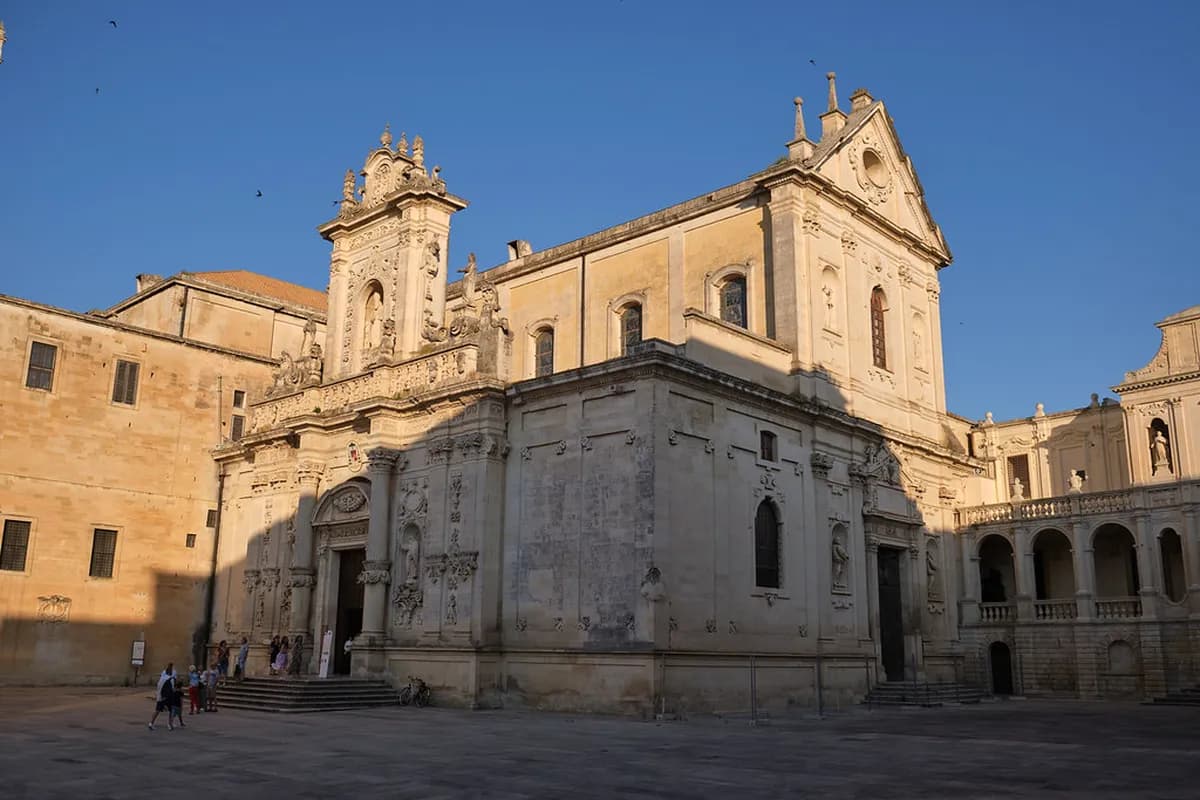
The Piazza del Duomo is routinely cited as one of the most beautiful squares in Italy, and it earns the praise. Unlike most Italian piazzas, this one has a single entrance passageway — stepping through the archway from Corso Vittorio Emanuele II feels almost theatrical, like a stage curtain being pulled back. The enclosed square is flanked by the Bishop's Palace, the Seminary, and the soaring 70-metre bell tower. The Cathedral of the Assumption of the Virgin Mary (the Duomo) itself was largely rebuilt between 1659 and 1670 by the local master Giuseppe Zimbalo, who gave it two facades — a restrained side face visible from the entrance and a full Baroque front visible only once you are inside the piazza. Allow at least 45 minutes here.
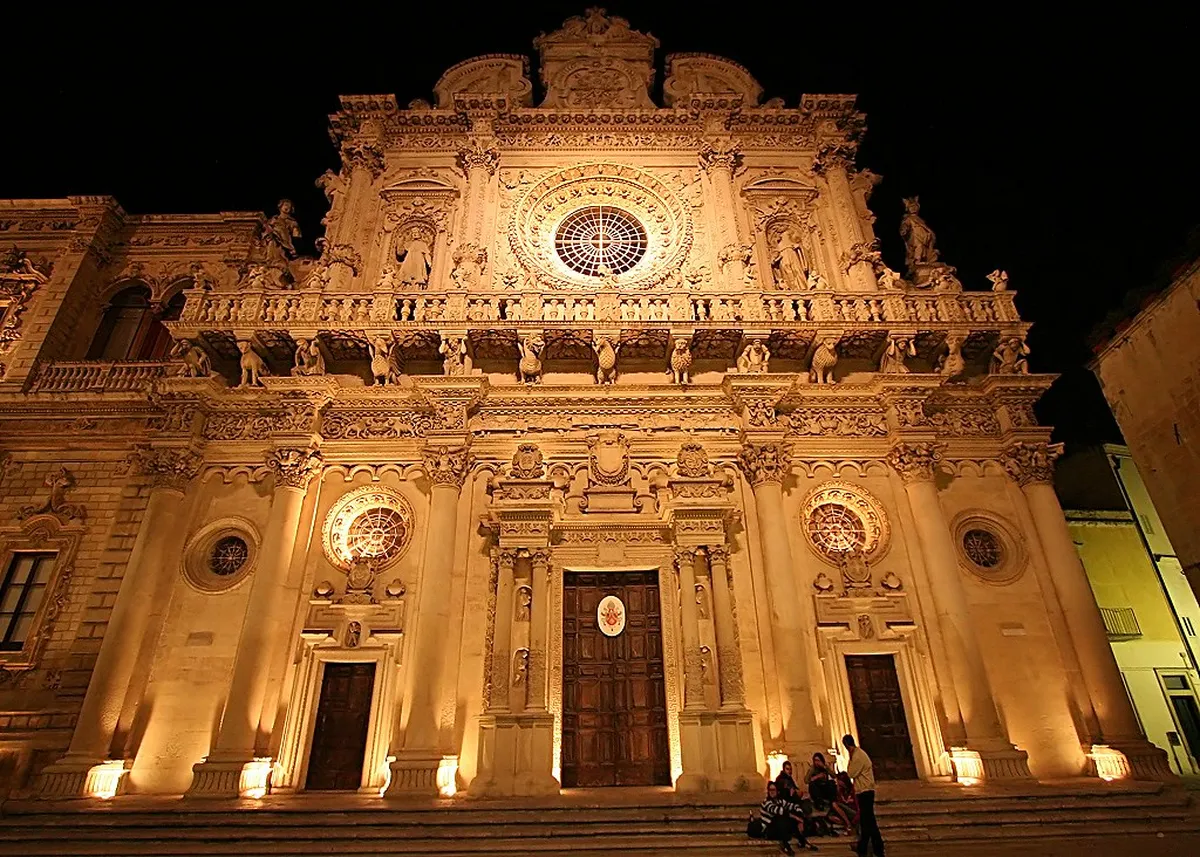
The Basilica di Santa Croce is Lecce's single most photographed building, and mid-morning is the ideal window to visit before the tour groups arrive in force. The facade took more than 150 years to complete (roughly 1549 to 1695) and involved at least five architects including Zimbalo. The upper section is a riot of carved figures: wild animals, mythological creatures, cherubs, twisted floral columns, and grotesques spill across every available centimetre of stone. The interior is calmer — a single-nave Latin cross with side chapels — but the Baroque ornament continues across altars, pilasters, and the gilded ceiling. If you are using the LeccEcclesiae pass, swipe it here; the Basilica is one of the five churches covered.
By noon you should be at Piazza Sant'Oronzo for the Roman Amphitheatre and a well-earned lunch stop. The Amphitheatre was discovered only in 1901 when workers began digging foundations for a bank. At its peak in the 2nd century AD, during the reign of Emperor Hadrian, it held around 15,000 spectators for gladiatorial games — roughly the entire population of the city at the time. Most of the structure remains buried beneath the piazza, but the excavated horseshoe of tiered seating is clearly visible from street level and entry to the visible sections is free. Roman Amphitheatre History (Atlas Obscura) has excellent background if you want deeper context before you visit.
For lunch, head to one of the pasticcerias within two minutes of Piazza Sant'Oronzo. A traditional pasticciotto — warm shortcrust pastry filled with silky custard, optionally lemon-spiked — is non-negotiable. Pair it with a caffè in ghiaccio and you have the definitive Lecce midday ritual. Prefer a fuller meal? The street food tasting and walking tour of Lecce covers multiple vendors and provides useful context on the cucina povera tradition. The rustico leccese — puff pastry filled with béchamel, mozzarella, and tomato — is another street food staple worth hunting down.
- Day 1: A deep dive into Baroque beauty
- Morning: 9:00 AM – 12:30 PM, Baroque tour
- Afternoon: 2:30 PM – 5:30 PM, Roman ruins
- Evening: 7:30 PM – 10:00 PM, Salento dinner
- Time: Approximately 13 hours total
- Logistics: Entirely walkable historic center
- Optional: Paper-mâché artisan workshop visit
Reserve Tickets Early: Lecce Booking Guide
Booking ahead is essential for a smooth one day in Lecce itinerary, particularly in the summer months of June through August when the city fills quickly. The single most useful piece of planning is choosing between the LeccEcclesiae multi-church pass and paying separately at each site. The table below shows exactly what the pass covers and what you save in 2026.
| Site | Individual entry (2026) | Included in LeccEcclesiae pass? |
|---|---|---|
| Basilica di Santa Croce | €3 | Yes |
| Cathedral of the Assumption (Duomo) | €2 | Yes |
| Church of Sant'Irene | €2 | Yes |
| Church of San Giovanni Battista (del Rosario) | €2 | Yes |
| Church of Santa Chiara | €2 | Yes |
| Total individual | €11 | — |
| LeccEcclesiae pass | €9 | All five |
The pass costs €9 and saves you roughly €2 compared to individual tickets, but the real saving is time — you queue once rather than five times, and on a one-day visit that matters. Buy it at any of the five participating churches on the day, or online in advance via the LeccEcclesiae website. Note that MUST (the civic museum in the former Monastery of Santa Chiara) and Museo Faggiano are not included in the pass and charge separately.
If you want a guided experience, book a Lecce walking tour with Paolo at least 48 hours in advance during summer; this two-hour expert-led walk is the fastest way to decode the layers of history compressed into the centro storico. Popular restaurants like Alle due Corti need reservations at least a day ahead — call +39 0832-242223 directly, as the website can be unreliable.
Museo Faggiano is a private site with limited daily capacity; I strongly recommend arriving right at opening (09:30) to avoid being turned away. The entry fee is €5 per adult. The museum tells the remarkable story of a homeowner who began digging to fix a leaking pipe in 2000 and accidentally uncovered 2,500 years of layered history — Messapian tombs, a Roman granary, a Franciscan chapel, and Knights Templar etchings — all beneath a single building in the historic center. It is one of Lecce's most memorable stops and easy to underestimate from the street.
Is one day in Lecce enough?
Many travelers ask if one day is sufficient for this Puglian gem. You can certainly see the main architectural highlights in about eight hours. Lecce is small enough to explore without feeling rushed on a day trip. I think it is the perfect duration for a first-time visitor.
However, staying longer allows you to experience the evening atmosphere properly. If you want to use the city as a Lecce base for Salento, plan three days. This gives you time for coastal excursions and slower, longer dinners. Check how many days in Lecce you really need for your style.
One day is enough for the history, but not for the lifestyle. You will miss the chance to browse all the artisan shops slowly. The local paper-mâché tradition deserves more than a quick look through windows. I would suggest an overnight stay if your Puglia schedule allows it.
Add an Extra Day: Salento Day Trips
If you have a second day, head to the coastal town of Otranto. It is about 35 minutes away by car or an hour by train. The cathedral there features a massive medieval floor mosaic of a tree. We loved walking along the castle walls overlooking the turquoise Adriatic Sea.
Gallipoli is another fantastic option on the Ionian coast of Puglia. This historic island town is famous for its fresh seafood and sunsets. The drive takes about 40 minutes from the center of Lecce. Public transit between these towns can be slow, so consider renting a car.
For a mix of nature and history, visit the Grotta della Poesia. This natural swimming pool is one of the most photographed spots in Italy. It is located near the archaeological site of Roca Vecchia on the coast. I recommend going early in the morning to avoid the largest crowds.
Lecce Planning Cheatsheet: Practical Tips
Parking in Lecce is tricky due to the ZTL (Limited Traffic Zone). The historic center is strictly off-limits to private cars; ZTL cameras operate continuously and fines are automatic. Use Parcheggio Ex Foro Boario near Porta Napoli — approximately €1 per hour, five-minute walk to the Basilica.
Walk into any bar in Lecce and ask for a caffè in ghiaccio con latte di mandorla. The barista will pull a standard espresso shot, drop it over a small glass of ice, and add a measure of sweet almond syrup. Do not add sugar — the syrup handles sweetness. Drink it quickly; this is not a leisurely sip. The ritual is strictly a summer drink, and ordering it in winter will get you a politely confused look. The phrase you need: "Un caffè in ghiaccio, per favore" — the almond milk is assumed at most Salento bars.
Most churches are open daily from 09:00 to 21:00 in summer (June–September). In winter, hours typically reduce to 09:00–18:00 and some secondary churches may be closed on weekday mornings. The Roman Amphitheatre view from street level in Piazza Sant'Oronzo is free and accessible at all hours. The Atlas Obscura entry on the Roman Amphitheatre provides excellent historical context for the site. Museo Faggiano opens at 09:30 and closes at 20:00 (€5 entry); arrive early as daily capacity is limited. The Roman Theatre opens Monday–Saturday 09:00–13:00 (€4 to enter the theatre and museum; free to view from the street gate).
Best time to visit Lecce: May, June, and September offer warm weather without peak-summer crowds. July and August are intensely hot (often above 36°C) and the city is packed with both Italian and international visitors, particularly during Ferragosto in early August. April is lovely — flowers everywhere and a relaxed pace — but some smaller restaurants and accommodation options may still be operating on reduced winter schedules. December is underrated: festive, atmospheric, and far quieter than summer, with Christmas light installations throughout the old town.
Roman Amphitheatre vs. Roman Theatre: What Is the Difference?
Lecce is unusual in that it contains two distinct Roman entertainment structures, and visitors frequently confuse them. Both date from roughly the 2nd century AD, both were hidden for centuries, and both were rediscovered during construction work. But they served completely different purposes and are separated by about a five-minute walk.
| Roman Amphitheatre | Roman Theatre | |
|---|---|---|
| Shape | Full ellipse (like a modern stadium) | Half-circle (like a modern theatre) |
| Capacity | ~15,000 spectators | ~4,000 spectators |
| Purpose | Gladiatorial combats and spectacles | Theatrical performances and music |
| Location | Piazza Sant'Oronzo — in the open, free to view from street level | Hidden in alleys off Via Arte della Cartapesta — easy to miss |
| Rediscovered | 1901 (during bank construction) | 1929 (during road works) |
| Entry cost (2026) | Free (street view); €3 to enter lower levels | €4 for theatre + Museum of the Roman Theatre; free to view from gate |
| Worth entering? | The street-level view is excellent; the lower levels add depth for history enthusiasts | The external view from the gate is very good; interior access is sometimes closed for restoration works |
The practical tip: see the Amphitheatre first during your midday stop at Piazza Sant'Oronzo, then walk to the Roman Theatre on your way to Museo Faggiano in the late afternoon. The Theatre is genuinely easy to miss — it is tucked behind a Baroque facade with a modest sign; if you do not know to look for it, you will walk straight past. If the interior access is open, the Museum of the Roman Theatre inside contains marble statues of Greek gods found on-site, which makes the €4 entry worthwhile.
Where to Eat in Lecce: Pasticciotto and Salento Cuisine
Lecce's food identity is rooted in cucina povera — the "food of the poor" that evolved over centuries in one of Italy's most historically impoverished regions. Meat was rarely affordable, so the Salento kitchen learned to do extraordinary things with vegetables, legumes, olive oil, and foraged ingredients. The result is a cuisine that feels simultaneously ancient and highly refined.
Two dishes are mandatory for any first-time visitor:
- Pasticciotto leccese — a warm oval shortcrust pastry filled with silky pastry cream (custard). The definitive version is from Pasticceria Natale, just off Piazza Sant'Oronzo. Always served warm; always eaten standing at the bar before 10:00. The debate about whether the custard should contain lemon zest is apparently still unresolved among local families.
- Caffè in ghiaccio con latte di mandorla — espresso poured over ice with a splash of sweet almond syrup. This is the Salento summer drink. Order it at any bar; it will arrive in a small glass, and you drink it quickly before the ice melts. Do not add sugar — the almond syrup already sweetens it. The full ritual name is caffè leccese.
For a proper sit-down lunch or dinner, the single most important address in Lecce is Alle Due Corti on Via Corte dei Giugni. Opened by Rosalba De Carlo in 1998 and now run with her son Giorgio as chef, it is a no-frills family trattoria that has been reviewed by the New York Times and featured on Anthony Bourdain's Parts Unknown. The menu is rooted in original cucina povera recipes: ciceri e tria (chickpeas with fried and soft pasta), polpette di melanzane (aubergine meatballs), and orecchiette con cime di rapa. Reserve by phone at least one day ahead (+39 0832-242223). The restaurant opens 12:40–14:00 and 19:40–22:30; closed Sundays.
For more casual eating: Mezzo Quinto is a hole-in-the-wall serving affordable Salento street food and small plates. Doppiozero offers traditional local cuisine in a slightly more contemporary setting and is a good alternative if Alle Due Corti is fully booked.
Where to Stay in Lecce
The first and most important rule: stay inside or directly adjacent to the historic center (centro storico). The old town has been comprehensively restored over the past fifteen years and is safe, walkable, and atmospheric at all hours. Staying outside it adds unnecessary transit time and disconnects you from the evening passeggiata culture that defines the Lecce experience.
The historic center has distinct micro-neighborhoods that behave quite differently at night. The area around the Basilica di Santa Croce, Piazza Sant'Oronzo, and Corso Vittorio Emanuele is busy and well-lit until midnight in summer. The area around the churches of San Giovanni Evangelista and Il Carmine is quieter and more dimly lit — still safe, but noticeably different in atmosphere. If you value liveliness, stay near the Basilica; if you want quiet, choose the Carmine end of the center.
- Splurge (€300–€500/night): Palazzo Bozzi Corso — ten individually styled rooms in a beautifully restored noble palazzo half a block from the Basilica di Santa Croce. The best address in the city.
- Mid-range (€150–€250/night): Palazzo de Noha — nine rooms in a converted historic palazzo just off Piazza Sant'Oronzo, with a lovely rooftop where breakfast is served beside a small pool. Patria Palace, which was recently renovated, offers old-world charm in a similarly central location.
- Budget (€100–€150/night): Palazzo Bignami — a reliable family-run B&B on the edge of the centro storico. Good value and well-reviewed for hospitality. Palazzo Marini B&B di Charme offers spacious, modern rooms with rooftop views at similar rates.
If you are only passing through for a single day and not staying overnight, Lecce's train station is a 15-minute walk south of the center and has left-luggage lockers. You can arrive in the morning, stow your bags, explore all day, and collect them before an evening departure.
Getting Around Lecce: Train vs. Car
Lecce has no airport of its own. The two realistic arrival routes are train and car, and each has meaningful tradeoffs depending on where you are coming from and what you plan to do during your visit.
By train — the easiest option if you are already in Italy. Trenitalia's high-speed Frecciarossa services from Roma Termini reach Lecce in approximately 5.5 hours, stopping in Bari and Brindisi. Tickets start from €25 booked in advance. From Bari, regional trains to Lecce run frequently (roughly every hour) and take 1.5 to 2 hours; from Brindisi the journey is just 30 minutes. Brindisi airport, which receives flights from London, Paris, and other European hubs, is the most convenient flying option — a direct taxi to Lecce costs around €50–€60 and takes 40 minutes. Lecce's train station sits about 1.5 km south of the historic center and is walkable in 15 minutes; taxis are available outside.
By car — useful if you are road-tripping around Puglia and plan to visit the Salento coast (Otranto, Gallipoli, Santa Maria di Leuca) as day trips from a Lecce base. Driving times: Bari 2 hours, Brindisi 40 minutes, Naples 3.5 hours. The critical issue with driving is the ZTL (Zona a Traffico Limitato). The entire historic center is off-limits to private cars and the ZTL cameras operate 24 hours a day. Violations result in automatic fines of €80–€165 that follow you home via your rental car company. The safest parking option close to the center is Parcheggio Ex Foro Boario, located just outside Porta Napoli on Via Taranto — a short five-minute walk from the Basilica di Santa Croce. It charges approximately €1 per hour and is the most consistently recommended option among visitors. There are also blue-line street spaces on streets outside the ZTL boundary, but these fill quickly in summer.
Once inside Lecce, everything is on foot. The historic center is fully pedestrianized and compact enough that you will rarely need more than ten minutes to walk between any two sights on this itinerary.
Cartapesta Workshops: Lecce's Living Artisan Tradition
One of the most distinctive and often overlooked aspects of Lecce is its cartapesta (papier-mâché) tradition. This craft has been practiced here continuously since the Baroque period, when artists needed a lightweight alternative to marble for creating the large figurative sculptures that decorated the interiors of churches — altarpieces, processional floats, ceiling decorations, nativity figures. Because Lecce's local limestone was expensive to carve in large three-dimensional forms, papier-mâché became the preferred medium for anything that needed to be hollow, light, or brightly painted.
Today, several workshops still operate in the historic center, and visiting one is a genuinely rewarding experience that most purely sightseeing-focused guides overlook. Look for workshop signs along Via Arte della Cartapesta (tellingly named) and the alleys around the Carmine church. Many workshops are open during the day and welcome visitors; you can watch craftsmen working on oversized saint figures destined for church interiors or smaller nativity pieces for private collectors. Prices for individual figurines start around €15–€30 for small pieces. If you want a more structured experience, a papier-mâché demonstration workshop (roughly 2 hours, approximately €40–€60 per person) can be booked through several local cultural operators. This is a much more meaningful souvenir than anything sold in the tourist shops around Piazza Sant'Oronzo, and it connects directly to the same Baroque impulse that produced every carved church facade in the city.
Frequently Asked Questions
What is the best way to get to Lecce?
Lecce is well-connected by train from Bari and Brindisi. The high-speed Frecciarossa train takes about 1.5 hours from Bari. If you are flying, Brindisi airport is the closest hub with frequent shuttle buses.
Is Lecce safe for solo travelers?
Lecce is considered very safe for solo travelers at all hours. The historic center is well-lit and usually busy with families in the evenings. Just follow standard precautions like watching your belongings in crowded piazzas.
What should I buy as a souvenir in Lecce?
Look for traditional cartapesta or paper-mâché figures made by local artisans. You can also find beautiful items made from the soft yellow Lecce stone. Local olive oil and dried pasta from the Salento region are also excellent.
Lecce is a city that captures the heart with its golden stone and warm hospitality. Even with just 24 hours, you can experience the best of its Baroque soul. I hope this one day in Lecce itinerary helps you plan a perfect visit. Enjoy the slow pace and the incredible flavors of the Salento region.
Remember to book your church pass early to save time and money. Whether you are here for the Roman ruins or the food, Lecce delivers. Safe travels through one of Italy's most beautiful and underrated southern cities.
You might also like

Continue reading
More guides you'll find useful